Operating in Colocation Spaces
Net-Zero Emissions
Akamai operates at the edge, which means a significant portion of our physical footprint resides in colocation data centers — facilities where we own the servers, but a partner owns the walls, cooling, and even the power delivery.
Historically, this model presented data visibility challenges. While we have clear visibility into our own IT load based on the data collection infrastructure that we engineered, the indirect emissions associated with the facility (cooling, lighting, and backup power) have often been less transparent due to varying reporting practices across providers.

The Akamai Solution: Contractual Intelligence
Akamai takes decisive action to resolve this ambiguity, shifting our posture from requesting improved data to partnering with our providers to secure it.
Our sustainability strategy now holistically addresses energy consumption across our entire infrastructure. To meet our 2030 targets, including net-zero emissions and 100% renewable energy, we look beyond the equipment we own to the critical services that support it. In colocation data centers, cooling, lighting, and uninterruptible power supplies (UPS) contribute significantly to our footprint, often reflected in power usage effectiveness (PUE) metrics.
Although contractual terms limit our direct control over site efficiency and utility procurement, we leverage our partnerships to bridge this gap. By engaging collaboratively with vendors, we advocate for the procurement of high-impact clean energy attributes and tighter efficiency standards. This approach ensures we are not just measuring our impact, but actively decarbonizing our value chain.
Our Approach to Operational Emissions Accounting
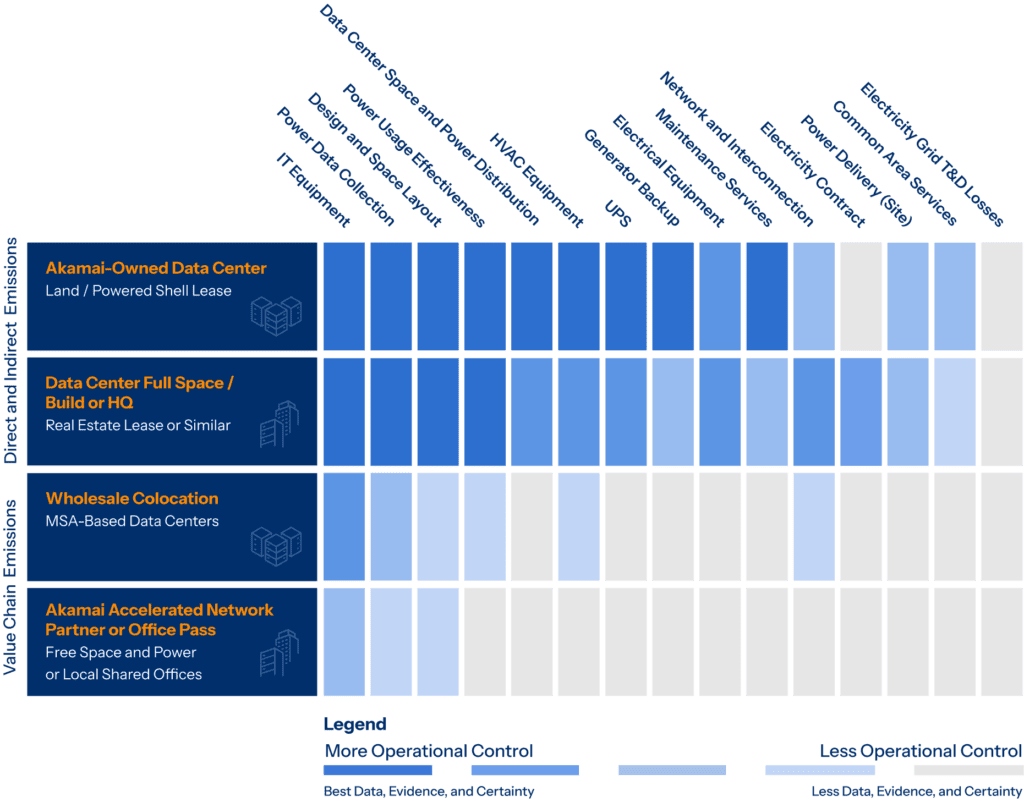
Standardizing GHG Accounting in Colocation Spaces
We recently expanded our data center survey, getting more specific data on renewable energy coverage and operational accounting. This was helpful for baselining suppliers’ sustainability strategies and accounting approaches to pave the way for deepened supplier engagement.
Akamai continued to partner with our colocation service providers to establish standardized accounting and reporting practices for emissions disclosures in our data center locations. Standardized emissions accounting that provides an approach to consequential traceability is crucial to ensuring accurate and consistent reporting, preventing issues such as double-counting or failing to report emissions values entirely due to assumptions that either providers or customers have accounted for. This effort is particularly critical as data center power demands continue to grow, amplifying the need for clarity and alignment in emissions reporting.
What are the Key Objectives?
- Ensuring our partners prepare GHG inventories that represent a true and fair account of their emissions by using standardized approaches and principles
- Increasing consistency and transparency in GHG accounting and reporting across organizations and programs1
Despite these objectives, Akamai, as a global customer of colocation services, has observed meaningful variations in how colocation providers interpret and implement the current GHG Protocol, the primary accounting guidance used by most companies today.
Even among providers with similar contract structures and power delivery models, reporting practices can vary. This diversity in reporting approaches presents opportunities to enhance standardized GHG accounting, enabling more consistent emissions tracking and improved industry-wide comparability. While the GHG Protocol offers a valuable foundation, there is potential to develop more consistent and actionable data practices across jurisdictions.
Inconsistencies in the Industry
The data center industry is currently navigating a diverse landscape of GHG accounting methodologies, and there is an opportunity for greater harmonization across providers. While the GHG Protocol offers helpful guidance, global providers may interpret boundaries differently, creating opportunities to strengthen reporting consistency.
- The All-In Approach: Some providers bundle customer energy use with facility energy use, which may create overlap where both the landlord and the tenant account for the same emissions.
- The Common Area Consideration: Others report primarily the energy used in shared spaces, which may not fully capture the significant cooling loads required to keep servers operational.
- The PUE Consideration: Many providers rely on power usage effectiveness (PUE) as a proxy for efficiency, though PUE alone may not capture the carbon intensity of the underlying energy sources.
We have observed variations like these in our own annual data center survey. For example, our most recent survey showed that 81% of respondents measure PUE at the building level, while less than 20% measure it for individual customers. While a low annualized building-level PUE indicates general data center efficiency, it lowers our ability to capture or reward individual tenant improvements. Localized efficiency efforts are averaged into the entire facility’s metrics, and with limited granular tracking, that ultimately lowers the ability for colocation customers like Akamai to invest in their own space-specific power-saving measures.
Variabilities like these lower the potential opportunity for the industry to work together. By establishing more consistent practices, that would help facilitate seamless industry-wide comparability and support collective progress toward net-zero.
Akamai’s Approach to Clarifying Accountability
To address these areas, Akamai is aligned on clarifying the interpretation of operational control in colocation spaces. This approach will assign emissions responsibility based on operational authority, which governs the activities and decisions impacting emissions. We aim to to work across the industry to establish clearer boundaries for:
Provider Responsibility
Also referred to as facility overhead. The provider holds the utility relationship and maintains the master meters. They are responsible for the emissions associated with the building’s operation — cooling, lighting, and power distribution losses. These are the provider’s direct Scope 2 emissions.
Customer Responsibility
To ensure consistency in our own approach, Akamai takes full ownership of the energy powering our infrastructure. Even though we sit behind the provider’s meter, we engage in active Scope 2 reporting by measuring, calculating, and reporting this IT load plus PUE as our Scope 2 emissions. This approach empowers us to take direct action by procuring high-quality renewable energy to match our consumption,
rather than passively
tracking it as a
supply chain
statistic.
Data Transparency
This accountability model requires precision. Because we report this as Scope 2, we cannot rely on rough estimates. We require providers to transparently assign energy use, distinguishing our specific IT load from the general facility overhead and ensuring that our renewable energy investments match our actual impact.
Moving Toward Industry Alignment
Akamai is supportive in fostering collaboration between colocation service providers and their customers to establish clear and consistent accounting practices. By working together to standardize the various approaches, we can enhance the accuracy of emissions reporting and unlock broader opportunities for meaningful decarbonization. Addressing reporting challenges will enable the data center colocation industry to focus on driving impactful initiatives, such as:
- Advancing clean energy procurement strategies
- Expanding investments in clean energy generation
- Innovating in energy efficiency and operational sustainability
Through these collective efforts, we strive to bridge gaps in emissions reporting, provide more granularity through our accounting, and inspire progress by promoting transparency and accountability across the colocation and data center ecosystem. We believe that by working together as partners, we can help lead the way toward a more sustainable future.
Incorporating Best Practices with CEBA
In partnership with CEBA, we have prioritized integrating environmental considerations into the strategic planning process for our global platform. Through our participation in CEBA, Akamai helped to create a guide of best practices for corporate colocation and cloud procurement, and put forth calls for our colocation providers to follow the same principles.
As a signatory of the Corporate Colocation and Cloud Buyers’ Principles, Akamai supports the following goals:
Options
Provide options for cost-competitive services powered by renewable resources that reduce emissions beyond business as usual
Data
Deliver monthly data on the colocation customer’s direct and indirect energy consumption, water consumption, greenhouse gas emissions, and other environmental data
Incentives
Align the partnership between customer and service provider, so both parties have an incentive to reduce energy consumption
Collaboration
Provide options for customer collaboration on efficiency and renewable energy enhancements
Disclosure
Disclose data for individual sites and total global corporate footprint, as well as site-specific energy sources
Advocacy
Engage in policy advocacy efforts that support the use of renewable energy
Helping to ensure our colocation and cloud service providers support these principles will help not only Akamai, but also other companies using their services, to meet sustainability goals.
1 Both objectives are foundational principles derived from the Greenhouse Gas Protocol (GHGP).