Our Philosophy on 1.5°C
Net-Zero Emissions
Akamai continues to accelerate toward the next phase of our climate strategy as we approach our 2030 corporate sustainability targets. We are using our scenario-based planning to secure our infrastructure against an increasingly volatile climate landscape. Our focus is squarely forward-looking: ensuring that Akamai’s global platform is not only on a credible pathway to achieving a 1.5°C-aligned future, but also is resilient enough to operate effectively across the full range of climate scenarios projected through mid-century and beyond.

Akamai’s Emissions First approach along with our public launch of CLIMATE, serves as the foundation of our strategy for addressing environmental impact to further build a resilient business model. We are prioritizing direct, measurable emissions reductions across our global operations and infrastructure, and it reflects our dedication to sustainability that scales with Akamai’s growth. Our pathway toward achieving net-zero by 2030 incorporates a series of adaptation and resilience measures tailored to meet the unique challenges of our expansive network.
Our revised pathway approach leverages insights from the IPCC’s Representative Concentration Pathways (RCPs), with a strategic emphasis on RCP 1.9 and 2.6, which are essential to limit global warming to 1.5°C. Akamai’s roadmap incorporates robust adaptation strategies across our global footprint, particularly in climate-vulnerable regions where data center resilience, energy efficiency, and renewable energy integration are imperative.
Frequently Discussed Topics
Understanding the IPCC RCP Framework
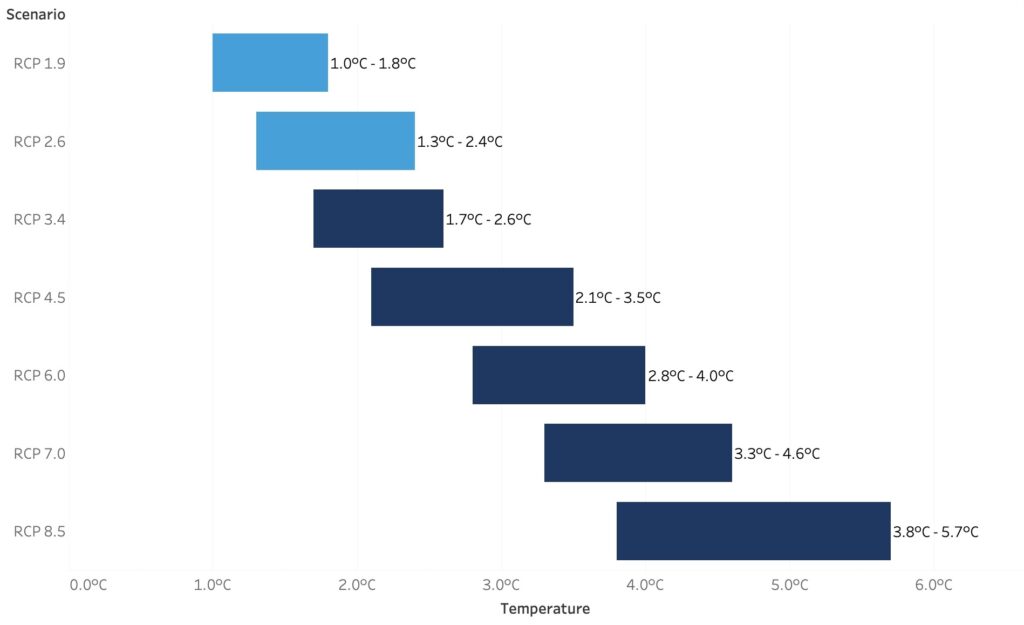
RCPs are standardized scenarios developed by the IPCC to project future greenhouse gas concentrations and their cascading effects on temperature, sea levels, and extreme weather through 2100. Akamai analyzes seven scenarios — from RCP 1.9 (limiting warming to 1.5°C, aligned with the Paris Agreement) to RCP 8.5 (business-as-usual, projecting up to 4.4°C warming). Each pathway is based on the IPCC Fifth and Sixth Assessment Report (AR5 and AR6) with updated climate sensitivity estimates and improved regional projections.
How Our Approach Differs — and Why It Matters
In response to evolving standards and the unique complexities of aligning our decentralized global network with the Science Based Targets initiative (SBTi), Akamai has decided not to pursue SBTi target setting under the current standard. SBTi focuses on emissions reduction target setting; the IPCC RCP framework is a scenario-analysis tool that addresses a broader set of strategic questions — physical, financial, and operational impact across seven distinct climate futures. The RCP framework enables region- and metro-level planning critical for globally distributed infrastructure, supports both mitigation and adaptation (not just emissions reduction), and directly supports CSRD/ESRS and IFRS S2 regulatory compliance through scenario-based financial disclosure.
We believe that our approach to transparent, robust annual reporting through CDP disclosures provides a comprehensive view of our emissions reduction progress, complemented by our hybrid disclosure framework anchored in the IFRS S1 and S2 standards — with IFRS S2 having superseded the TCFD serving as our global baseline for climate-related financial disclosure. We augment this foundation with specific insights from the established TCFD framework to provide deeper visibility into our physical risk management and adaptation planning.
Akamai also aligns its science-based climate commitments within a comprehensive, RCP-driven strategy. Recognizing that our impact extends beyond our direct operations, we partner with our supply chain to advance these shared goals, establishing a standard that encourages our suppliers to adopt a science-based approach aligned with IPCC RCP scenarios and SBTi, and/or maintain active ISO 14001 certification.
| Traditional Approach | Akamai’s Approach | |
|---|---|---|
| Primary Focus | Emission reduction | Emission mitigation and adaptation (not just reduction) |
| Scope | Guidance, criteria, and recommendations companies need to set science-based net-zero targets consistent with limiting global temperature rise to 1.5°C | Assessment of physical, financial, and operational impact across seven distinct climate futures (not just 1.5°C) |
| Operational Utility | Benchmarking corporate climate action, accelerating implementation, strengthening collaboration across the ecosystem, and scaling impact | Enabling region- and metro-level planning critical for globally distributed infrastructure |
| Regulatory and Disclosure Alignment | CDP, CSRD/ESRS, IFRS S2 | CDP, CSRD/ESRS, IFRS S2 |
How Akamai Uses the RCP Framework
Akamai’s analysis evaluates climate impacts across three core business units: cloud computing (data center vulnerability, cooling challenges, energy supply disruptions), security (cybersecurity threats during climate events, physical security failures), and content delivery (network infrastructure damage, latency degradation, edge location concentration risk). Under more rigorous climate models, the broader cloud computing and content delivery sectors may experience increased operational costs and an elevated potential for physical infrastructure impacts over the long term. To proactively manage these variables, we are implementing tailored adaptation strategies across our key global markets — building resilience against diverse local environmental dynamics, from coastal water levels in Miami and Amsterdam to seasonal precipitation patterns in Chennai.
The Business Case for Climate Resilience
Enterprise buyers continue to factor sustainability into procurement decisions, which is why our scenario-based financial modeling evaluates capital expenditures, operating expenses, and potential pass-through costs across a comprehensive range of climate pathways. Analysis indicates that while pass-through costs from our colocation partners remain relatively stable under highly mitigated climate scenarios, they are projected to increase under higher-emission pathways. However, by implementing our recommended suite of adaptation measures, we can substantially mitigate this climate-related cost exposure. We view early, proactive action as a strategic investment that yields strong returns through avoided operational disruptions, sustained efficiencies, and enhanced market positioning.
Aligned with Science-Based Pathways
Akamai’s sustainability commitments — 100% renewable energy, net-zero emissions, efficiency, and circularity — are mapped directly onto RCPs. The framework simultaneously drives adaptation including continued compute decentralization, geographic diversification, AI-driven cooling, and disaster recovery redundancy. Our work with our suppliers is focused on an achievable approach including pursuing a science-based approach aligned with IPCC RCP frameworks (AR5/AR6), the integration of the SBTi or ISO 14001 certification to address Scope 3 emissions.
Leading Together: Cross-Industry Climate Action
Akamai collaborates with the Corporate Energy Buyers Association (CEBA), Ceres Corporate and BICEP Network, and the Information Technology Industry Council (ITI) to pursue sustainable energy policies and climate resilience. Our support of The Climate Pledge reinforces our dedication to achieving net-zero emissions, complementing our existing reporting and allowing us to build a resilient, forward-looking sustainability program. This includes EU policy engagement (CSRD, European Green Deal), North American advocacy (Transmission and Permitting Reform and state renewable portfolio standards), and Asia-Pacific and Latin American energy partnerships.
Building a Resilient Digital Future
Akamai’s climate resilience strategy is integral to our broader pathway toward a 1.5°C-aligned future. As our organization continues to expand, we remain focused on embedding sustainability across the company, ensuring that our operations not only progress toward net-zero goals but also build the resilience necessary to thrive in a carbon-constrained world. This holistic approach underscores Akamai’s role as an industry leader in sustainability, setting a course that aligns with the latest climate science and international standards. Explore Akamai’s full IPCC RCP Analysis executive summary, review the Sustainability and Impact Reports, and contact Akamai’s sustainability team for partnership opportunities.